An Artist on Intuition, Creative Freedom and the Joy of Experimentation
What are you currently exploring in your artistic practice that excites you the most?
At the moment, I am particularly drawn to the creative space in between – the conscious act of pausing, letting go of familiar paths and remaining open to whatever may emerge next. Trust is becoming increasingly important to me. Trust in the creative process, in not having to know or determine everything in advance, but instead allowing things the space to unfold in their own way. I am fascinated by the idea that this openness can give rise to something I might never have imagined or planned beforehand. At the same time, I am exploring how to bring more of the freedom, vitality and joy I experience while creating art into my everyday life. How can I remain curious outside the studio, trust my own impulses and approach life with the same openness as a blank canvas?
For me, this is an exciting journey of discovery – without a predetermined destination, but with plenty of curiosity and trust in whatever may unfold.

Is there a particular artwork on your Singulart profile that best represents your artistic practice today?
Tell us why you chose it.
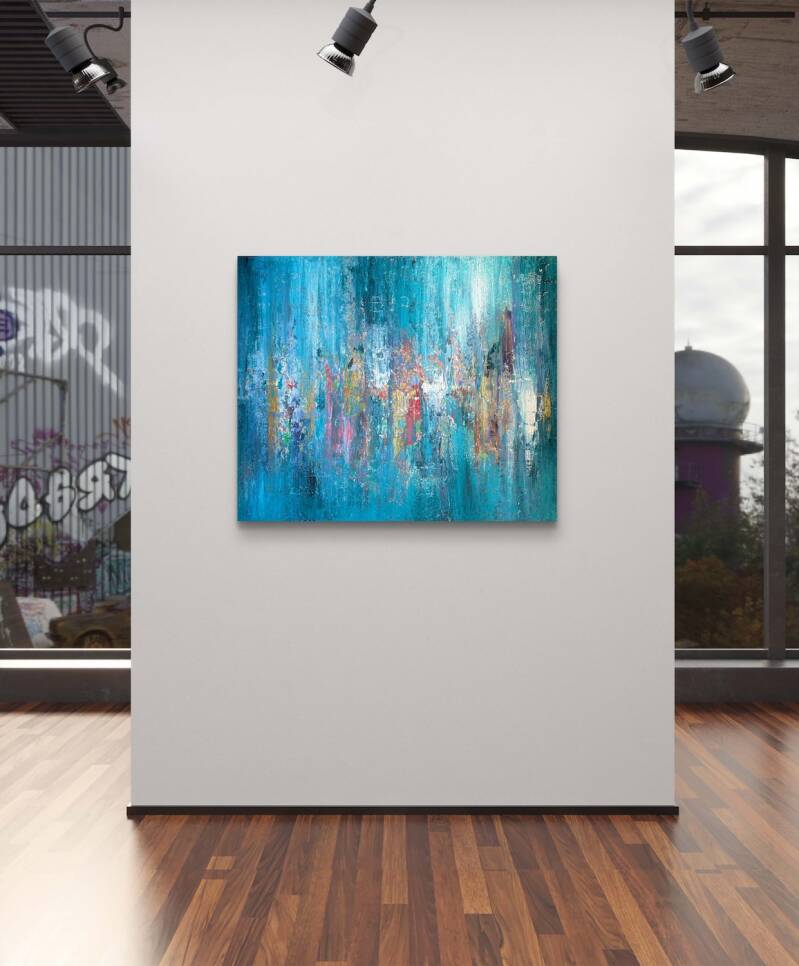
WILD & FREE is one of my most recent works, and it feels like a significant milestone in my artistic journey. With its intense colors, layered textures and three-dimensional elements, it brings together forms of expression that I have been working and experimenting with for a long time. What makes this piece particularly special to me, however, is less about the technique and more about what I experienced during its creation. I can feel that my trust in my own artistic process has grown. In the past, I would often question my decisions or the finished artwork after painting. Today, I am increasingly able to embrace my different forms of expression and allow each of them its own space. For me, WILD & FREE embodies precisely this development - the freedom to follow a creative impulse without subsequently measuring the result against a particular expectation. Even the unexpected or seemingly imperfect can become part of the journey and give rise to something entirely unique. That is why this artwork represents more than artistic freedom to me. It also marks a personal step towards greater trust in my own artistic voice – with all its different facets and the possibilities that still lie ahead.
Which experiences, places or moments have had the greatest influence on the artist you are today?
The greatest influence on my artistic development has probably been life itself – particularly the experiences that led me to question familiar beliefs and search for my own path. For many years, I repeatedly tried to adapt to expectations and societal conventions. At the same time, I often felt that I did not truly fit into the structures that were already in place. I questioned many things and wondered what actually felt right and authentic to me personally. There were periods in my life that were particularly challenging, when I withdrew from my usual everyday routines. Looking back, it was often during those very times that new possibilities began to emerge. That is how art eventually entered my life. Not through a grand plan or a conscious decision to become an artist. It began simply with an impulse to try something new, without knowing where it might lead me. What I did not realize at the time was what an extraordinary space I was about to discover for myself. While in other areas of life I had often tried to meet expectations, painting suddenly allowed me to be completely different. I could experiment, follow my own impulses and allow something to emerge without having to conform to predetermined ideas. These experiences – searching for my own path, navigating challenging periods of life and unexpectedly discovering a space in which I could create with complete freedom – have profoundly shaped me as an artist.


Is there a lesser-known story from your artistic journey that has shaped who you are as an artist today?
One perhaps lesser-known aspect of my artistic journey is that I originally had very little involvement with art. Neither art history nor particular artists or artistic movements played much of a role in my life. And to be honest, that has not changed all that much to this day. I have always been more of a hands-on person. Rather than studying theory first, I preferred to experiment, discover and gain my own experiences. Looking back, I believe that was actually a gift. Had I spent more time studying the work of other artists, I might have tried to follow their example instead of discovering my own unique artistic expression. While painting, I felt alive and free. I had found a form of expression that allowed me to give space to things for which I sometimes could not find the words. But as soon as the creative process was over, my rational mind would often step in with the question: "Is this actually art, or should I just throw it away?" And indeed, over the years, I gave up painting several times, disposed of my paints and even threw away numerous canvases – including, in retrospect, some truly beautiful works. But apparently, art was not so easily persuaded to leave my life. Eventually, that inner calling would return, and I would begin again. Today, I understand that seemingly imperfect works, painted-over canvases and unexpected turns are all part of the artistic process. Perhaps my greatest challenge was never creating art, but allowing myself to recognize what emerges through me as art in the first place.
Are you currently working on anything you would like to share?
One idea I am currently exploring is opening myself up more to individual commissioned artworks again. At the beginning of my artistic journey, I created several pieces for people in my personal circle. What fascinated me most was the surprising and often deeply personal meanings these artworks came to hold for the people who viewed them. Over the past few years, I have mainly focused on exploring and developing my own artistic expression – as free as possible from external expectations or fixed ideas about what should emerge. Now I find it exciting to consider bringing these experiences together in a new way.
Someone might bring personal wishes regarding the format, colors
or materials, while the actual creative process remains open, allowing the artwork to develop intuitively. Whether this will lead to something, and what form it might take, is something I am deliberately leaving open.
For now, it is simply a possibility that sparks my curiosity.


You originally trained and worked in the hospitality industry before finding your way to painting as a self-taught artist. How have your professional experiences shaped your artistic journey and your perspective on creativity?
My professional experiences in hospitality, later in sales management and the world of start-ups, shaped me in a very different way from painting. These environments often required working within established structures, taking responsibility, adapting flexibly to new situations and finding creative solutions to a wide variety of challenges. Looking back, I believe this was one of the ways my creativity expressed itself at the time – less through artistic creation and more through thinking, organizing and developing ideas. When I later discovered painting, I encountered an entirely different form of creativity. Suddenly, it was no longer about finding the right solution to a particular task or achieving a predetermined goal. I could simply experiment, follow my impulses and allow something to emerge without needing to know where it would lead. Today, I recognize the value of both worlds of experience. My professional background has given me skills that also benefit my independent artistic practice – particularly when it comes to organizing, developing and bringing my own projects to life. At the same time, painting has opened up a new perspective for me: Creativity does not always need a goal, a purpose or a particular outcome. It can also emerge simply for its own sake.
Your artistic approach is based on intuition and letting go of fixed concepts, allowing the moment and your feelings to guide you. How do you continue to embrace this openness and spontaneity, and what role does the unexpected play in your process?
For me, it is less about consciously deciding to be spontaneous again and again, and more about following a kind of inner calling. Creativity often arises like a wave that suddenly begins to move. I feel an impulse, an inner energy seeking expression. That is why it is important for me to create enough freedom in my everyday life to actually follow these moments when they arise. When that creative surge arrives, I do not want to have to start planning or organizing first. Everything else can wait, and I simply head into the studio. The actual creative process often feels like a dance. An impulse arises and is immediately translated into action. From there, the next step emerges – a new movement, a new color or texture. I am completely present in the moment, connected to my senses and to whatever is happening. Thinking fades into the background, and I follow what reveals itself naturally.
The unexpected plays an essential role in this process. Precisely because I do not know what the finished artwork will look like, I can immerse myself fully in the present moment. If I already had a fixed outcome in mind, part of my attention would probably be focused on reaching that destination. Instead, every step remains a discovery. It is this interplay of intuition, movement, surprise and direct experience that makes painting such a special joy for me.


You primarily paint with acrylics on canvas and playfully experiment with materials such as small stones and modeling paste. What fascinates you most about this approach, which seems to reflect a child's carefree curiosity?
What fascinates me most about this way of working is the incredible range of possibilities that emerges when different materials interact. I love experimenting with generous amounts of paint, modeling paste, small stones and a variety of techniques. Each material has its own unique characteristics, and when they come together, surprising textures, shapes and connections continually emerge. This gives my artworks a particular sense of depth, three-dimensionality and vitality. An important part of my creative process is the immediate, physical experience. I work extensively with my hands, feeling the different materials and allowing their qualities to inspire me. Often, the canvas lies on the floor so that I can move freely around it and work from different directions. Painting therefore becomes a very dynamic, almost dance-like process for me. It is not simply about applying colors and materials to a canvas, but about entering into a lively dialogue with them. And this is precisely where that carefree, childlike curiosity comes into play: the joy of experimenting, discovering and playfully exploring whatever is possible in the moment. Without needing to understand or control everything beforehand. I believe part of my enthusiasm simply comes from having preserved this sense of playfulness. From still being able to marvel at the new worlds that emerge through the interaction of materials, movement and spontaneous impulses.
You describe your art as a kind of mirror in which everyone can discover something of their own.
Has there been a particular encounter or response from viewers that has especially moved or surprised you?
What continually touches and surprises me is the incredible variety of perceptions that a single artwork can evoke. Sometimes people discover shapes, movements or connections in my paintings that I had not even noticed myself. Others feel drawn to a particular color, an atmosphere or a deeply personal memory. I find it fascinating how closely the experience of viewing an artwork can be connected to someone's own life story, experiences and emotional state at that particular moment. While one person may primarily notice the colors, textures and interplay of materials, another might discover something deeply personal that cannot necessarily be put into words. That is precisely why I initially chose not to give my artworks titles. I did not want to suggest a particular perspective, but rather allow viewers to discover their own unique connection with a piece. Later, I began expressing my personal associations and feelings through the titles as well. Recently, however,
I have found myself revisiting the question of how much room I want to leave for individual interpretation – without the title already guiding someone's perception in a particular direction. Ultimately, what touches me most is precisely this openness: The fact that an artwork can mean something different to every person, and that through encounters with viewers, I continue to discover new aspects of my own work.

Alongside your artistic practice, you are also a passionate vegetarian cook. Do you see any connections or parallels between creating in the kitchen and creating on canvas?
Yes, absolutely! Looking back, I even believe that my passion for intuitive cooking laid an important foundation for my later artistic development. Long before I began painting, I loved experimenting in the kitchen. I followed spontaneous ideas, combined ingredients that might not seem to belong together at first glance and allowed myself to be surprised by the new flavors that emerged. Through this, I gradually learned to trust my intuition and act on creative impulses immediately, rather than questioning them first or planning everything in advance. Often, this led to dishes I would probably never have discovered by following a conventional recipe. Today, I recognize a wonderful parallel with my painting. In front of the canvas, too, I follow spontaneous impulses, experiment with different materials and delight in unexpected combinations.
Perhaps intuitive cooking prepared me, in a very playful way, to place greater trust in my own creativity – long before I ever considered becoming an artist.
Original German Version: HERE